
Contract Works Insurance – What Happens if Remedial Works for Damage and Construction Defects Overlap?
/In contract works claims, a frequent dispute – for both insurers and insureds – is precisely where to draw the line between cover for new “damage” and excluded construction defects. The damage and defects are often interlinked and untangling the issue involves technical evidence.
The decision of the Supreme Court of New South Wales in Acciona Infrastructure Australia Pty Ltd v Zurich Insurance plc UK Branch [2026] NSWSC 185 is a recent example in which the line was blurred. The same repair work was required to address storm damage and a pre-existing defect.
Background – Storm Damage to Defective Property
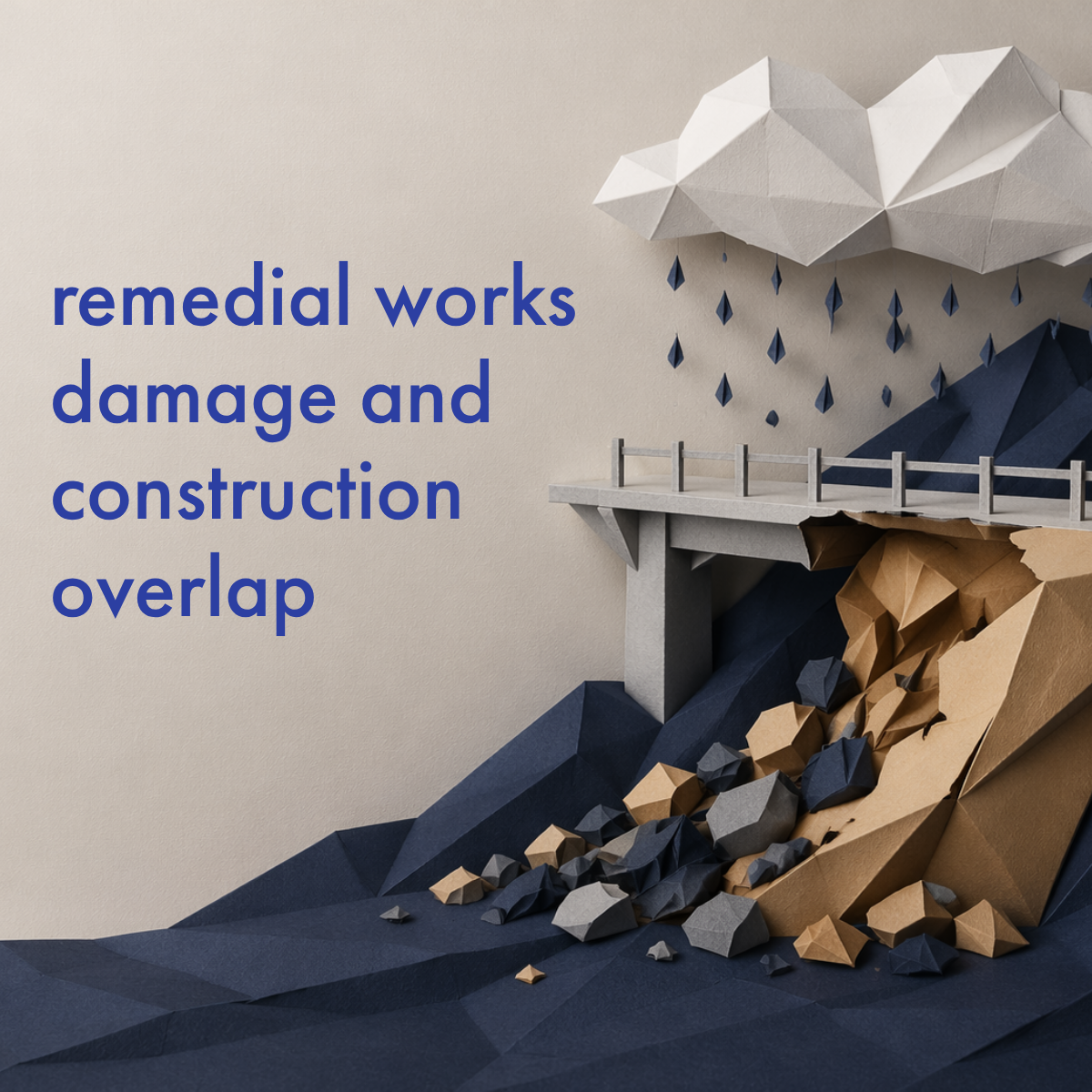
The dispute concerned an insurance claim under a contract works policy for alleged storm damage to an embankment on a roading infrastructure project.
Acciona was the design and build contractor for upgrade work on the Bruce Highway in Queensland. Acciona alleged that, during construction, severe weather events in February and May 2015 caused damage to an embankment by saturation of fill. Acciona claimed for that damage under its contract works policy.
The insurers declined cover for the remediation costs to the embankment. They pointed out that the embankment was defective due to non-conforming fill. They argued that remedial works were carried out pursuant to Acciona’s contractual obligation to rectify that defect.
Court’s Decision – Dual Purpose of Repair Work
Given the technical engineering nature of the dispute, and volume of materials (over 10,500 pages), the Court had referred the matter to a referee, who found in favour of Acciona. The Court adopted the referee’s report and held that the insurers were liable for the remedial work to address the damage, even though that same work was required to address the construction defect.
The referee viewed the dispute as “binary”, in that the policy distinguished between damage (which was covered), and construction defects (which were not covered). Significantly, on the policy wording, “there was no dispute that provided damage was identified and required repair, the policy would respond, even if there were also defects requiring repair”.
The insurers argued that the repair works were only required due to the defect, that is, the non-conforming fill. But the referee did not agree. The repair work was carried out for two purposes: namely (i) to repair the defect, and (ii) to repair the damage within the policy coverage. So, Acciona was entitled to cover for that remedial work even though it also repaired the defect.
The Court awarded judgment of $2,109,335.42 to Acciona.
Comment
This Australian decision turned upon the policy wording, which provided cover for the cost of repairing the damage, even if the work also repaired the construction defect. It was sufficient that one purpose was to repair the damage. The outcome would likely have been different if the policy had a stronger defect exclusion, which clearly excluded cover in cases of overlap. With a clear exclusion, the well-known Wayne Tank principle may have applied, which holds that an exclusion prevails when a loss has concurrent causes (one of which is covered and one of which is excluded). The case is a helpful reminder that analysis of the ‘defect’ vs ‘damage’ divide should be tailored to the policy wording in question.

andrew durrant is a special counsel at fee langstone